Lucid Air Shocks Hot Rod Drag Week: Electric Meets Tradition
Hot Rod Drag Week, an annual testament to the "street car" ethos, has evolved far beyond its initial purpose of silencing doubters. Conceived over two decades ago by David Freiburger, the event challenges participants to drive their high-performance vehicles over 1,000 miles in a week, stopping at a different dragstrip each day to prove their street-legal credentials. What started with a humble 40 entries has exploded into a highly sought-after competition, with hundreds vying for a coveted spot.
In the 2025 edition, the event's growth was palpable. Spots sold out rapidly, and a lengthy waitlist underscored the event's popularity. This year, one participant even shipped their Corvette from New Zealand, highlighting the event's global appeal.
The core tenet of Drag Week remains unchanged: no support vehicles are allowed. Competitors must carry all necessary tools, parts, and tires in their vehicles or trailers, adding to the challenge and demanding meticulous preparation.
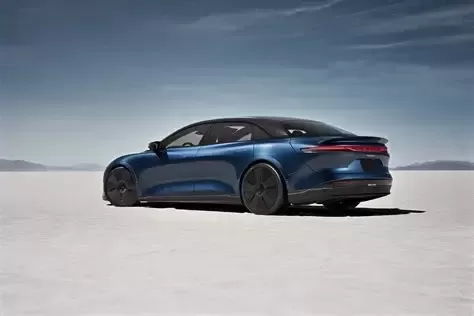
This year, an unexpected contender emerged: a Lucid Air Sapphire. Entered not to stir controversy, but to explore its capabilities in a demanding real-world scenario. Its blend of high horsepower and luxurious comfort sparked a debate: could an EV find acceptance among die-hard hot rodders?
The Lucid's participation was made possible by recent NHRA rule changes, which now permit newer stock vehicles to run quicker times without requiring additional safety equipment. With its impressive quarter-mile performance, the Sapphire teetered on the edge of these limits, potentially facing disqualification if it exceeded speed or time thresholds.
The Drag Week route for 2025 spanned several states, beginning and ending in Maryland, with stops at various dragstrips. The relatively short 660-mile journey belied the challenges that lay ahead.
At the starting line, the Lucid faced initial skepticism. Many racers were unfamiliar with the brand and dismissive of its electric powertrain. However, this perception began to shift as the week progressed.
The Sapphire was placed into the Street Machine Eliminator class, with an elapsed time limit of 10.000 seconds and slower. Strategically, the driver had to avoid going too fast in the quarter mile, and get handed a 20-second penalty that would destroy any chance of overall victory.
While other competitors battled mechanical failures and overheating, the Lucid's primary concern was range. Its substantial EPA-rated range, however, proved more than adequate for the daily drives.
Along the route, the Lucid encountered other EV conversions, showcasing the growing interest in electric hot rodding. These included a ratty Chevy Business Coupe powered by a Tesla motor and a Chevy El Camino with forklift motors.
The first day presented a unique challenge: balancing speed with adherence to class rules. A too-quick run resulted in a near-disqualification, highlighting the precision required to succeed in the Street Machine Eliminator class.
Despite the initial skepticism, the Lucid began to win over the crowd. Its impressive performance and innovative technology sparked curiosity and even admiration.
Commentators on the event's livestream also took notice, acknowledging the Lucid's capabilities while grappling with their preconceived notions about EVs.
The challenge of managing the Sapphire's speed at the end of the track became apparent. Regenerative braking, while beneficial for range, made it difficult to fine-tune the car's speed to avoid exceeding the 150-mph limit.
In contrast to the Lucid's relatively smooth journey, many other competitors faced significant mechanical hurdles. Engine failures, broken transmissions, and other issues tested their resourcefulness and determination.
The Drag Week community rallied to support those in need, sharing parts, tools, and expertise. This camaraderie, combined with the enthusiasm of roadside spectators, underscored the unique spirit of the event.
As the week progressed, the Lucid's performance improved, and its acceptance within the hot rodding community grew. Even the internet commentators began to express grudging respect.
On day four, a head-to-head race between the EV conversions captivated the crowd, further demonstrating the potential of electric hot rodding.
Despite occasional setbacks, the Lucid persevered, ultimately earning the respect of competitors and spectators alike.
Even small details became points of discussion, like the car alarm going off when the nearby cars made too much noise.
The final day saw the Lucid crossing the finish line, securing a place in Drag Week history as the first year with so many EV entries. While not a class winner, the Lucid's participation served as a catalyst for discussion and a demonstration of the evolving landscape of automotive performance.